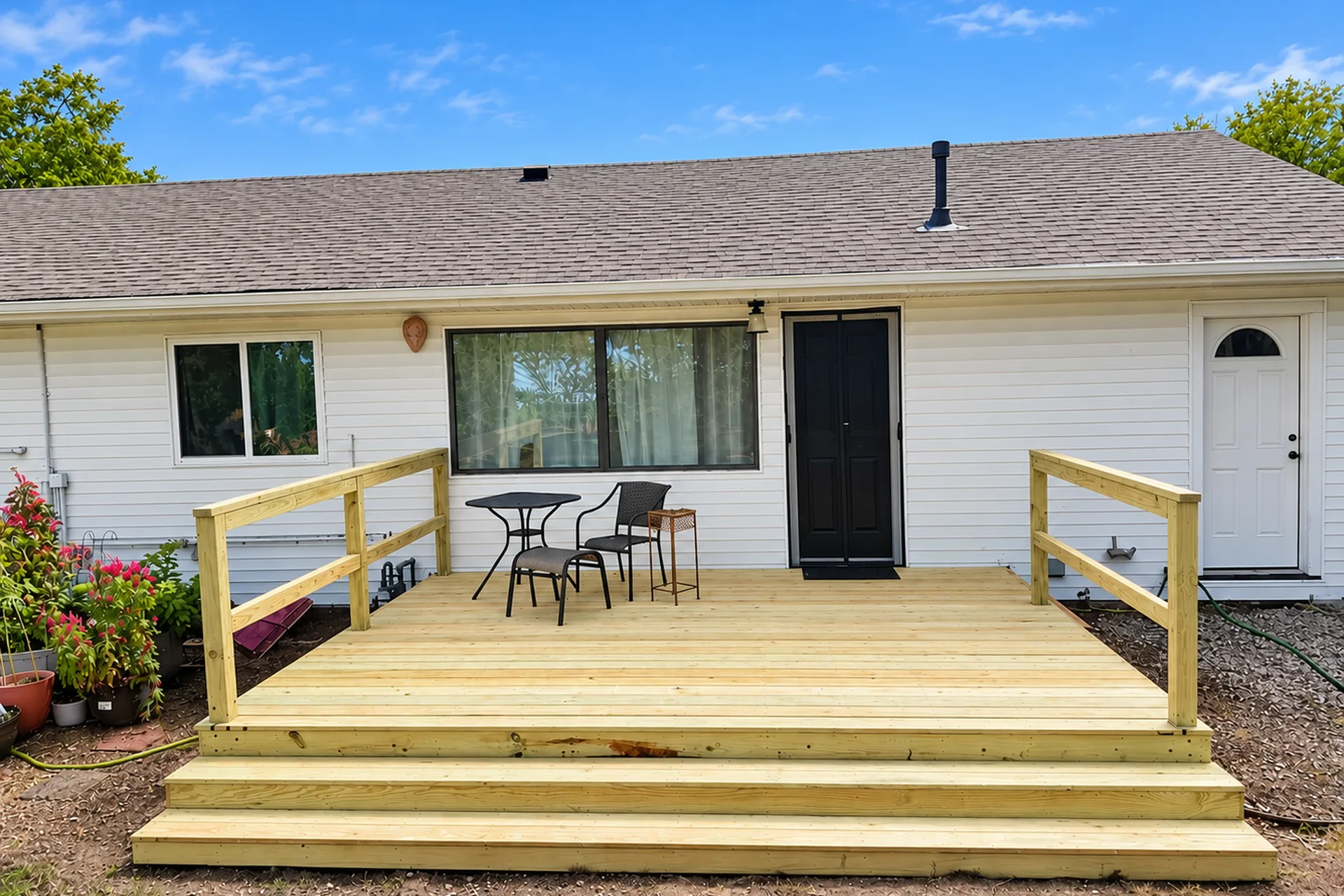
Deck Replacement in Nashville: Tear Out the Old One, Build It Right
A deck built in the 1990s has done its job. Twenty-five Tennessee summers later, the question is not whether to keep patching it, but how much longer the patches will hold. Nashville Deck Builders tears out failing decks across Middle Tennessee and rebuilds them to current code, with new footings where they are needed, properly flashed ledgers, modern hardware, and your choice of pressure-treated wood or composite. One crew, one written number, and the old deck hauled away.
When a Deck Is Past Repair
Most homeowners call about a symptom: a board that gives, a rail that sways, a stair that bounces. Those are all repairable on a sound frame, and if that is what you have, our deck repair page is the one you want. Replacement enters the conversation when the problem is underneath the surface, in the parts of the deck that hold everything else up. Once the structure is compromised in more than one place, fixing it piece by piece costs more than starting over, and it never quite gets you a deck you can trust.
Here is what tips a deck from repair to replacement when we open it up:
- Framing rot. A single bad joist can be sistered. When a screwdriver sinks into three or four of them, or into the beam they rest on, the whole frame is on the same clock.
- Ledger failure. The ledger is the board that ties the deck to the house. Rot behind it, nails instead of bolts, or no flashing at all is the single most common cause of deck collapse, and it is rarely worth saving a ledger from that era.
- Undersized joists and beams. Many older decks were framed with 2x6 joists on wide spacing or beams that span further than today's tables allow. They sag, they bounce, and they cannot be made to pass a modern inspection without rebuilding.
- Posts on dirt or surface blocks. Posts buried in soil or sitting on pavers rot from the bottom and shift with the ground. Proper footings are poured concrete below frost depth, and retrofitting them under an old frame is often more work than new framing.
- Pre-2000s hardware. Thin galvanized joist hangers, nailed-only connections, and the absence of lateral load ties are typical of decks from the 1990s. Rusted hangers and corroded fasteners are a replacement signal, not a touch-up.
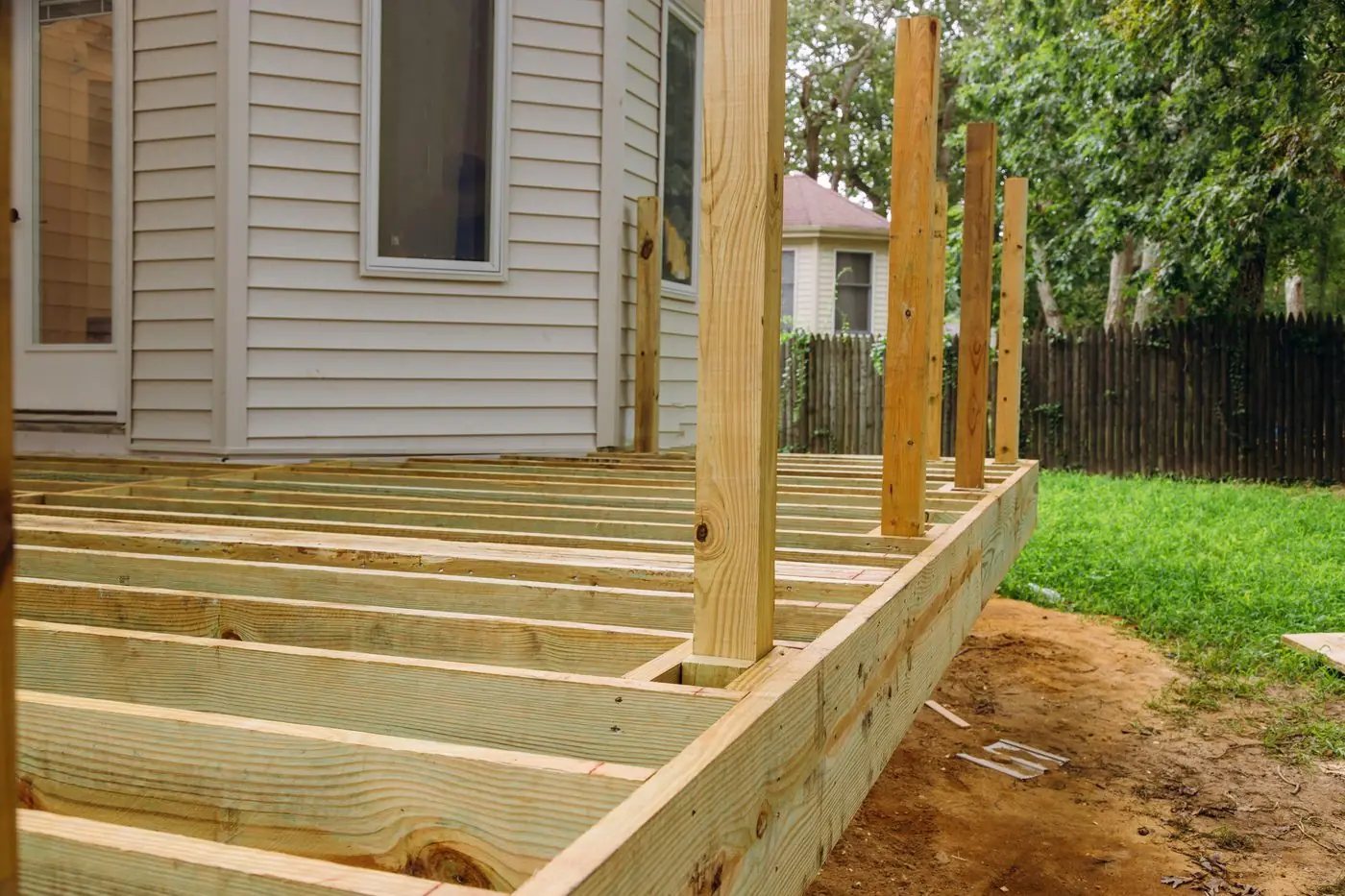
What a Full Deck Replacement Involves
A replacement is a new deck with a demolition in front of it. That sounds obvious, but it matters for how we quote and schedule the work: everything you would expect from a new deck build is here, plus the labor and disposal of taking the old one apart safely and leaving the yard clean.
The sequence on a typical replacement looks like this:
- Demolition and haul-off. Decking, railing, stairs, and framing come down in that order. Every board, nail, and screw leaves in a trailer or dumpster, and we sweep the ground before footings go in.
- Footings: reuse or replace. Existing poured footings that are the right size, in the right place for the new layout, and below frost depth can stay. Anything on blocks, in dirt, or in the wrong spot gets new concrete.
- New ledger with real flashing. The siding comes off where the deck meets the house, the sheathing is inspected for damage, and a new ledger goes on with structural lag screws or through-bolts behind a layer of metal and self-adhered flashing. Water that gets behind the ledger is what rots the house, not just the deck.
- Modern hardware. Hot-dip galvanized or stainless hangers rated for treated lumber, lateral load connectors, post bases set on the concrete, and joist tape on every top edge to keep water out of the fastener holes.
- Current code throughout. Guard height of at least 36 inches with balusters spaced to stop a 4-inch sphere, graspable handrails on stairs, consistent stair rise and run, and a ledger attachment that meets today's prescriptive tables instead of guesswork from 1994.
- Decking, railing, stairs, and finish. Pressure-treated, cedar, or composite surface, your railing choice, and stairs built to land on a proper pad rather than bare ground.
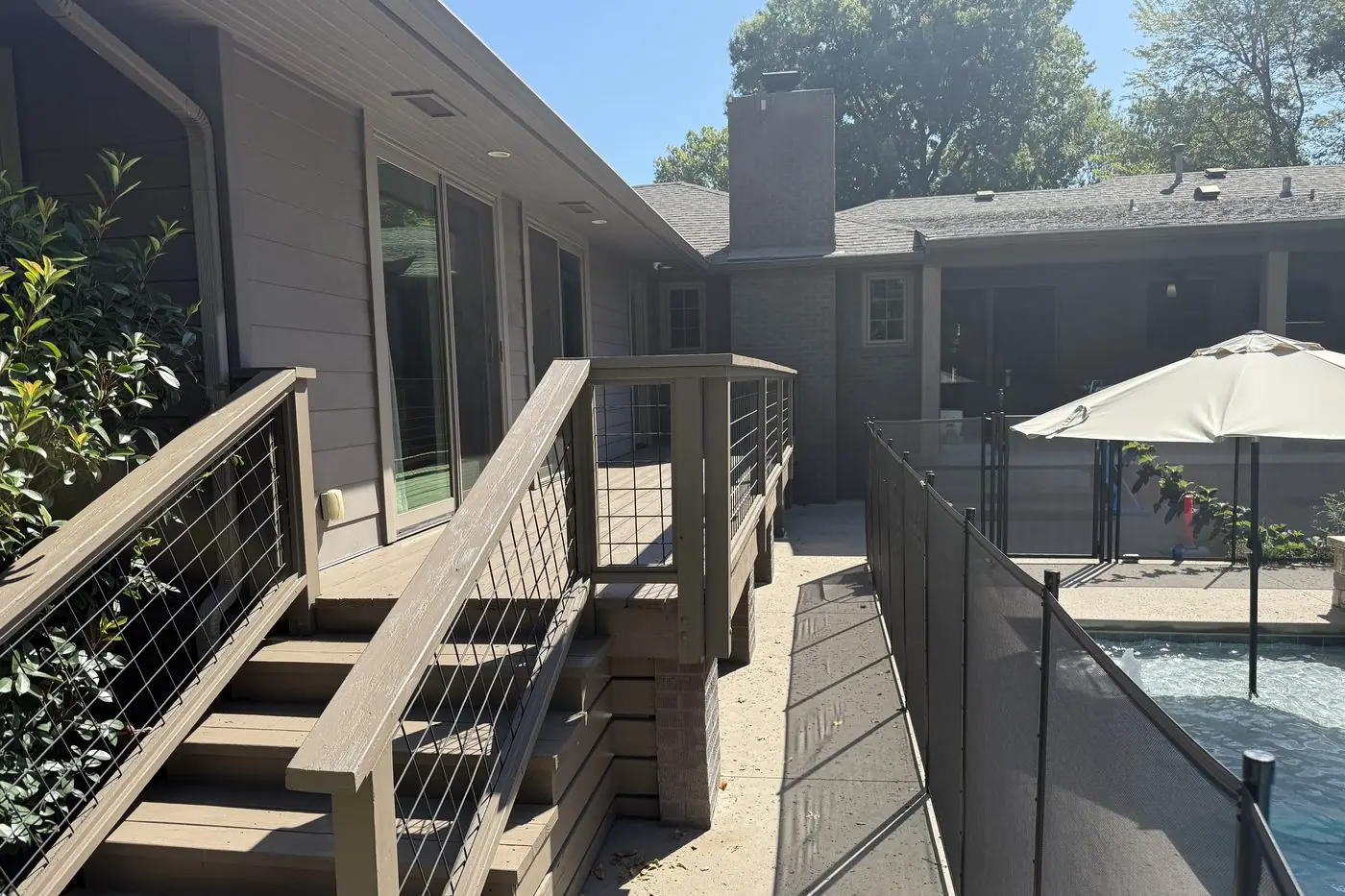
Same Footprint or Redesign? Replacement Is the Moment to Decide
Because the structure is coming out anyway, replacement is the one time you can change your deck's size, shape, height, or material without paying for anything twice. Plenty of homeowners rebuild exactly what was there, and that is a sensible choice when the footprint already works. But if the old deck was too small for a table, faced the wrong way, or baked in the afternoon sun, now is when it costs the least to fix that.
The three redesign conversations we have most often:
- Go bigger. A 1990s deck was typically a 12 by 12 or 12 by 16 landing off the back door. Extending to 16 by 20 or wrapping around a corner adds seating and dining space, and the incremental cost is mostly decking and framing rather than a second mobilization.
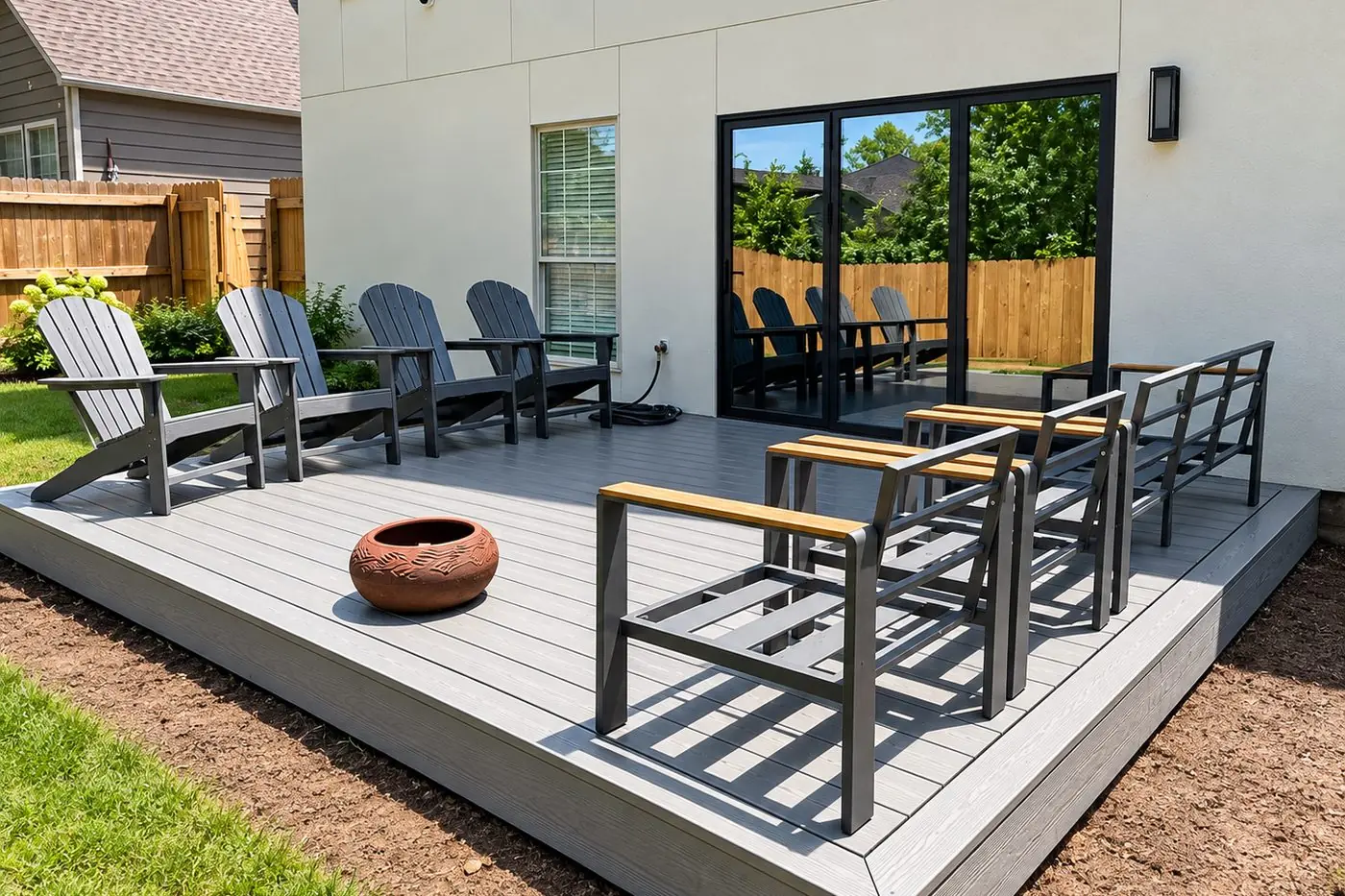
- Switch to composite. If you are tired of staining, replacement is the natural point to move to composite decking. The frame is new and built to the tighter joist spacing composite boards call for, so you get the full warranty life out of the surface.
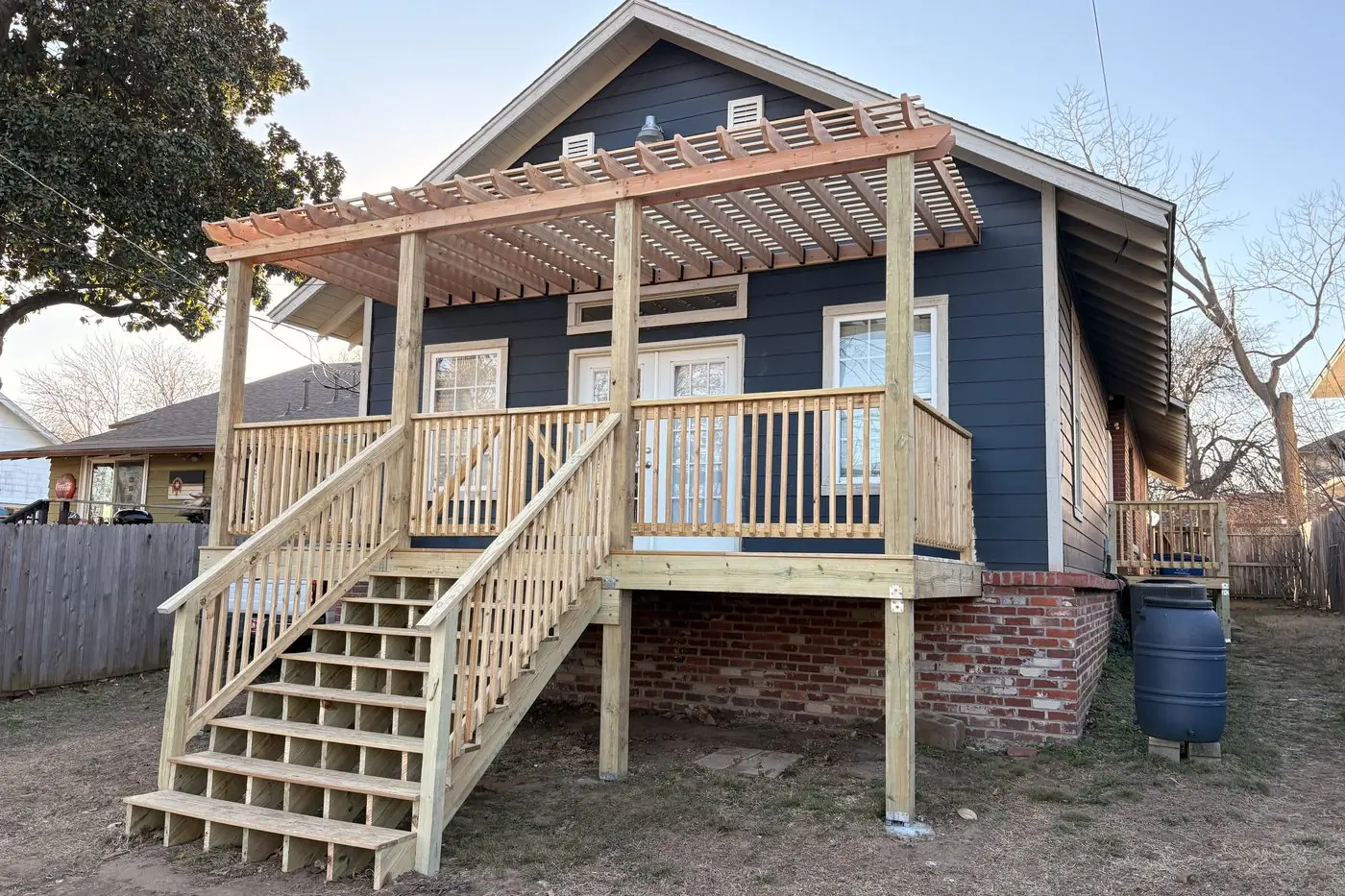
- Add a covered section. A roof over part of the deck turns it into usable space in July and in a thunderstorm. A covered deck is a different structure with different footings and a tie-in to the house roof, so it is far easier to plan it into a rebuild than to bolt it onto a finished deck later. Our screened porch page covers the fully enclosed version.
Whatever direction you choose, we draw it before we quote it. The drawing is what goes to the permit office and, where it applies, to your HOA, so you will see the deck on paper before anyone orders lumber.
Deck Replacement Cost in Nashville
Replacement pricing starts with the same per-square-foot ranges we publish in our Nashville deck cost guide, then adds the demolition and disposal of the old deck. The ranges below are typical 2026 installed prices for the Nashville metro; the only number that counts is the written quote, and it will not move once work starts.
$30 – $45 / sq ft
Pressure-Treated Rebuild
The budget route for a like-for-like replacement. A treated frame and treated decking, built to current code with modern hardware. Expect to stain every two to three years to keep it looking the way it does on day one.
$55 – $85 / sq ft
Composite Rebuild
A treated frame under capped composite decking and, usually, aluminum railing. Board tier and railing style set the price inside the range. Covered sections run $100 to $160 per square foot because you are buying roof framing, and a cedar or treated pergola over the deck adds $6,000 to $20,000 depending on size.
+ $1,000 – $3,000
Tear-Out and Disposal
Demolition, hauling, and dump fees for the old deck sit on top of the per-square-foot number. Size, height, and how far the trailer can get from the deck decide where in the range you land. Permit fees are included in your quote as well; Metro Nashville requires a permit for any deck replacement, and the surrounding cities and counties set their own fees.
Timeline: From Site Visit to Finished Deck
The build itself is the shortest part of a replacement. The time before it, when drawings are approved and permits are issued, is where schedules are won or lost, and we start that clock the day you sign.
- Site visit and written quote: about a week. We measure, probe the existing frame, check footings and the ledger, and talk through footprint and materials. The quote comes back as a flat number with a drawing.
- Permit and approvals: varies by jurisdiction. Metro Nashville, Franklin, Brentwood, Hendersonville, and the surrounding counties each run their own permit office. Our deck permit guide walks through what each one looks for. Add HOA architectural review in many Williamson County neighborhoods, which can take several weeks depending on when the committee meets.
- Demolition: one to two days. The old deck comes down, the ground is cleared, and footing locations are marked and called in to Tennessee 811.
- Footings and framing: three to six days, with inspections. Footings are inspected before concrete, framing is inspected before decking. We schedule both so the crew is never waiting on a date.
- Decking, railing, stairs, and final inspection: three to six days. Surface, rails, stairs, trim, and a walkthrough with you before the final inspection is called in.
All told, plan on one to two weeks of crew time on site for a straightforward replacement, longer for covered or multi-level builds. We give you a realistic start date with the quote and keep you posted if a permit office or the weather moves it.
Why Replacing Often Costs Less Than a Decade of Repairs
A failing deck does not fail all at once. It fails one invoice at a time: a railing this spring, a beam next year, stairs the year after, and a re-stain in between each. Every one of those repairs is money spent on a frame that is still aging underneath. Middle Tennessee is unusually hard on wood, which is why decks here age faster than the same deck would in a drier climate.
Humidity and Rain
Nashville averages well over 50 inches of rain a year, and the summers are humid enough that wood rarely dries out fully between storms. Treated lumber resists rot, but the treatment does not reach the center of a board, and every cut end, fastener hole, and ledger seam is a path for water. Thirty years of that is why the 1990s decks we tear out are soft from the inside.
Freeze-Thaw and Clay Soil
Middle Tennessee winters cycle above and below freezing dozens of times. Water in a check or a joist hanger expands, splits the wood a little further, and lets in more water. Below grade, the region's heavy clay soils swell when wet and shrink when dry, which heaves and tilts shallow footings and the posts on them. A deck that has drifted out of level is usually telling you about the ground.
Termites and Old Hardware
Subterranean termites are active across Tennessee, and a post sitting on soil or a stair stringer resting on the ground is an invitation. Pair that with thin, pre-2000s galvanized hardware that has been corroding against treated lumber for decades, and the connections that hold a deck together are often the weakest part of it. New framing on proper footings with current hardware resets all of it at once.
Put the numbers side by side and the pattern is clear. Serial repairs on a tired frame — a railing one year, a beam the next, stairs after that, with a re-stain between each — can add up to a meaningful share of a new deck over ten years and still leave you with a deck that needs replacing at the end. A new deck, built right, with permits and inspections behind it, holds its value, passes a buyer's inspection, and does not ask for a structural repair for a generation. We are glad to run both columns for your deck so you can see the comparison on paper.
Deck Replacement Questions, Answered
How do I know my deck needs to be replaced instead of repaired?
Look at the frame, not the surface. Rot in the ledger, beams, or more than a couple of joists, posts sitting on dirt or cracked blocks, hardware that has rusted through, or a frame that was undersized to begin with all point to replacement. Cosmetic problems — gray boards, a loose rail, a few soft planks — point to repair. We open the structure up, show you what we find, and give you both numbers if it is close.
How much does it cost to replace a deck in Nashville?
Start with the new-build number: roughly $30 to $45 per square foot for pressure-treated wood and $55 to $85 per square foot for composite on a treated frame. Then add tear-out and disposal of the old deck, which typically runs $1,000 to $3,000 depending on size and access. A 16 by 20 composite replacement with aluminum railing, for example, usually lands in the low-to-mid twenties once demolition is included. Your written quote is one flat number covering all of it.
Do I need a permit to replace my deck in Nashville?
Yes. Metro Nashville's codes department treats replacing a deck the same as building a new one — both require a building permit — while simply tearing a deck down with no rebuild does not. The surrounding cities and counties run their own permit offices with their own rules. We pull the permit, submit the drawings, and schedule the footing, framing, and final inspections on every replacement we build.
Can you reuse my existing footings or deck frame?
Sometimes the footings, rarely the frame. Poured concrete footings that are sized correctly, below frost depth, and in the right spots for the new layout can often stay. Framing is a different story: by the time a deck is a replacement candidate, the joists and beams are usually at or near the end of their life, and new decking on tired framing is money spent twice. If the frame genuinely passes, we will tell you — that job is resurfacing, not replacement, and it costs less.
How long does a deck replacement take?
On site, most replacements run one to two weeks: a day or two for demolition and haul-off, footing and framing with inspections in between, then decking, railing, and stairs. Covered sections, multiple levels, and long stair runs add time. Before the crew arrives, plan on a permit window that varies by jurisdiction, and in Williamson County neighborhoods an HOA review that can add several weeks. We give you a realistic start date with the quote.
Is it worth upgrading to composite when I replace my deck?
Replacement is the cheapest moment you will ever have to switch materials, because the frame is being built new either way. Composite costs more up front than pressure-treated wood, but it removes the staining and board replacement cycle that wears out a wood deck in Tennessee's climate. If you plan to stay in the house ten years or more, the math usually favors composite. If you are selling in two, treated pine is a perfectly good answer.
Davidson, Williamson, and Sumner Counties and Beyond
Replacement work takes us across the metro every week: older neighborhoods inside Nashville where 1980s and 1990s decks are reaching the end, and the first ring of suburbs where builder-grade platforms came with the house. We handle the permit through whichever office owns your address and prepare the HOA packet where one is required. See our local pages for deck builders in Franklin, deck builders in Brentwood, and deck builders in Hendersonville, or the full list on our service areas page.
Find Out What Your Deck Is Really Standing On
One site visit tells us whether your deck is a repair or a replacement, and you leave with a written answer either way. Call now or send your project details and we will schedule the walk-through.
Straight Talk From Homeowners We Have Worked For
Quoted from public Google reviews of our crew. Names shortened for privacy, nothing else changed.
“From demo to completion, they were professional and kept a very tidy workplace. The Trex composite decking and aluminum railing brought my house to upscale Nashville standards.”
“They went above and beyond to ensure there were no nails or screws left for my kids to step on. The proposal with the quote was very clear and detailed and the final price was exactly what was estimated.”
“They did an awesome job, very professional and done RIGHT!”
Tell Us About the Deck You Have Now
Rough size, how old it is, what it is doing that worries you, and what you would want from the new one. We will schedule a site visit, open up the frame, and come back with a flat written number for the replacement, or tell you honestly that a repair will do.
Prefer to talk? Call (615) 468-0133